

『High Volume Air Flow Meter Stations: Environmental Particulate Sampling and Vane Anemometer Audits』Related information(flow rotameter|digital flow meter|balo meter|hydraulic flow meter|volumetric meter|positive displacement meter|pitot tube flow meter|displacement meter|cfm meter|variable area flow meter|inline flow meter|differential pressure flow meter|calibrated flow meter|velocity meter|paddle wheel flow meter|oval gear flow meter|anemometer hvac|multiphase flow meter|doppler flow meter|thorpe tube flowmeter|heat flow meter)
High Volume Air Flow Meter Stations for Environmental Particulate Sampling and Vane Anemometer Audits
Quick Answer: A high volume air flow meter station needs a stable gas mass flow reference for PM10 and PM2.5 sampling. Silver Automation Instruments supplies thermal mass flow meters with 4-20 mA HART output. These meters fit DN50 to DN300 ducts and simplify vane anemometer audits in hot humid sites.
What the Station Does
A high volume air flow meter station records the sample air flow for ambient particulate monitoring. A typical high volume sampler pulls about 1.13 cubic metres per minute. That is 40 cubic feet per minute. The station measures actual flow so the lab can calculate concentration in micrograms per cubic metre. If the flow reading drifts, the reported concentration drifts. Field engineers see this on coastal sites in Vietnam and Indonesia where humidity changes fast.
The station usually includes a flow meter, a temperature sensor, a pressure transmitter, and a paperless recorder. Some stations add a vane anemometer port for audits. The recorder logs flow, ambient temperature, filter DP, and barometric pressure. This data supports sample validity checks required by many environmental agencies.
Flow Requirements for Particulate Sampling
The common reference methods for PM10 and PM2.5 set a defined sample flow. A PM10 high volume sampler runs near 1.13 m3 per minute under actual conditions. A PM2.5 sampler runs near 1.0 m3 per minute depending on the inlet design. The flow measurement error should stay within 2 percent of reading for audit work. Some local standards allow 4 percent full scale. That sounds loose but it is not.
In practice, many audits fail because the reference flow meter does not account for line pressure and temperature. A volumetric vane anemometer reads velocity only. It does not read mass flow. You then convert the reading using air density. That conversion adds error on a hot afternoon. Because of this, many teams use a thermal mass flow meter as the station reference.
Thermal Mass Flow Meters in High Volume Air Stations
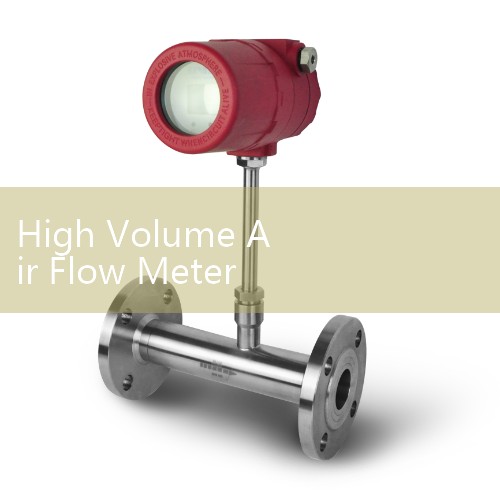
A thermal mass flow meter from Silver Automation Instruments measures gas mass flow directly. It does not need a separate pressure sensor and temperature transmitter for density compensation. The insertion probe fits a DN50 to DN300 duct. The electronics output 4-20 mA HART and Modbus RTU. Accuracy is plus or minus 1 percent of reading from 0.5 to 40 normal metres per second. That covers high volume sampler flow with margin.
The measuring principle works well in ambient air. The sensor has a heated PT100 reference and a temperature sensor. The gas flow removes heat. The meter measures the mass flow signal. This method is stable in humid air and works in Thailand, Philippines, and Saudi Arabia. One customer in Malaysia replaced a differential pressure flow rig with a thermal mass flow meter. The new meter cut audit time from two hours to about forty minutes.
Vane Anemometer Audit Procedure
A vane anemometer audit compares a handheld vane anemometer against the station reference. The technician places the vane probe in the duct or at the sampler inlet. The station display shows the reference flow. The handheld meter shows a velocity. The tech converts velocity to flow using the duct area. The reading difference must be within the audit limit. A common limit is 5 percent of reading.
Field note: the vane probe needs a stable flow profile. Swirl and elbows before the probe cause low readings. Most engineers skip this part. Then the audit fails. Use at least 10 duct diameters of straight run before the measurement point. If space is limited, use a flow conditioner. That one change fixes many repeatability issues.
Recommended Station Components
For a high volume air flow meter station, we suggest a complete set and not just a flow meter. The core is a thermal mass flow meter with an insertion probe. Add a PT100 temperature sensor for ambient a
The flow meter can be ordered with ATEX Zone 1 certification if the station sits near a gas processing plant fence line. For standard ambient air stations, IP66 housing is enough. Stainless steel wetted parts work for coastal sites. We have supplied stations for fence line monitoring in Nigeria and Qatar. Specify 316L probes for those sites.
Installation Details That Reduce Drift
Mount the flow meter probe in a straight section. Keep the probe tip at the centre of the duct where the velocity profile is stable. Do not install the probe behind a filter or a damper. The probe needs at least 5 duct diameters downstream of the filter. If the probe is too close, the flow signal is noisy. The station PLC or recorder will show a sawtooth pattern. That noise is not a meter fault. It is a location fault.
For portable stations, secure the probe cable and the recorder. Vibration from a sampling pump or a generator can loosen the terminals. We see this on customer sites many times. Use shielded cable for the 4-20 mA signal and keep it separate from the pump power cable. This reduces 50 Hz or 60 Hz noise.
Maintenance and Audit Schedule
Clean the thermal mass flow sensor every six months in dusty areas. A blocked sensor reads low. Use compressed air or a soft brush. Do not touch the sensor tip with your fingers. Oil from skin changes the heat transfer. Check the zero point every quarter. Some sites do this before each audit. The zero check takes five minutes and needs no special tools.
For vane anemometer audits, run the audit monthly in high traffic months and quarterly in slow periods. Record the reference flow, ambient temperature, barometric pressure, and duct area. If the difference jumps above 5 percent, check the probe position first. Then check the vane anemometer battery. Low battery causes low readings.
FAQ
Question: Can a thermal mass flow meter handle the high flow volume of a PM10 sampler?
Answer: Yes. Most high volume samplers run near 1.13 cubic metres per minute. A thermal mass flow meter with an insertion probe covers this flow range easily. We size the probe for the duct diameter and flow velocity.
Question: Does the station need temperature and pressure correction?
Answer: A thermal mass flow meter does not need separate density correction for normal ambient air. A vane anemometer audit still needs air density correction because it reads velocity. Our station records temperature and barometric pressure for audit calculations.
Question: What output signals does the station provide?
Answer: The standard flow meter has 4-20 mA HART and Modbus RTU. The paperless recorder accepts 4-20 mA HART, PT100, and pulse inputs. You can export data to USB or send it over Ethernet.
Question: Can you supply a complete high volume air flow meter station?
Answer: Yes. Silver Automation Instruments supplies the flow meter, PT100 sensor, pressure transmitter, paperless recorder, and a stainless steel panel. We prewire the station and test it at our Nanjing factory before shipping.
Question: Which industries use these stations?
Answer: Environmental monitoring agencies, cement plants, mining sites, oil and gas fence line projects, and industrial hygiene teams use them. We have supplied customers in Malaysia, Vietnam, Philippines, Nigeria, Qatar, and Mexico.
Send us your air flow range, duct size in DN, ambient temperature range, and pressure. Our engineers will recommend a thermal mass flow meter, PT100 sensor, and recorder set for your station. Contact Silver Automation Instruments. Tel: +86-25-68650347. WhatsApp: +86-25-52155837. WeChat: +86 15365082610.
 Hot Product
 Related AD