

『Fire Sprinkler Flow Meter Testing: Verifying Water Motor Alarm and Inspector Test Connections』Related information(flow rotameter|digital flow meter|balo meter|hydraulic flow meter|volumetric meter|positive displacement meter|pitot tube flow meter|displacement meter|cfm meter|variable area flow meter|inline flow meter|differential pressure flow meter|calibrated flow meter|velocity meter|paddle wheel flow meter|oval gear flow meter|anemometer hvac|multiphase flow meter|doppler flow meter|thorpe tube flowmeter|heat flow meter)
Fire Sprinkler Flow Meter Testing: Verifying Water Motor Alarm and Inspector Test Connections
Quick Answer: A flow meter on a fire sprinkler inspector test line verifies that the water motor alarm receives enough flow and that the inspector test connection delivers the correct flow for one sprinkler. Portable clamp-on ultrasonic units work well for temporary audits. Permanent electromagnetic meters are better for fire pump test lines and continuous monitoring.
Most maintenance teams check a pressure gauge and then wait for the water motor gong. They ignore actual flow rate. Pressure alone cannot tell you if a pipe is partially blocked, if an alarm line strainer is plugged, or if a valve is half shut. A flow meter gives direct evidence in litres per minute or gallons per minute. That evidence is what a building inspector or insurance surveyor accepts.
What Is a Water Motor Alarm and Why Flow Testing Matters
A water motor alarm is a mechanical bell driven by moving water. It is part of the wet pipe fire sprinkler system and must be tested under NFPA 25. During the test, water flows through the alarm line and drives the gong. The inspector test connection is normally located at the end of the most remote branch. Opening that connection simulates the flow of one sprinkler head. If the flow is too low, the alarm may not sound within the required time. Some electronic flow switches also fail to trigger because the flow falls below the minimum threshold.
Here is the thing. Many fire systems sit stagnant for months. Rust, scale, and debris collect in test connections and alarm lines. A flow meter catches those restrictions before a real fire does. In practice, a facility that tests with a flow meter finds leaks, closed valves, and worn check valves sooner than a team that only watches the pressure needle.
Inspector Test Connections and Flow Verification
An inspector test connection is a small pipe branch with a valve and a smooth bore outlet. It is not a drain. The orifice size is selected to approximate one sprinkler discharge at a given pressure. When you open the valve, the system should flow at the designed rate. A clamp-on ultrasonic flow meter can be placed on the branch or on the riser pipe to read that flow. Because the branch is often short and close to a valve, the better location is usually the main riser or the feed main. That pipe has more straight run and is easier to install the transducer on.
Flow Meter Types for Fire Sprinkler Testing
For temporary checks, a portable ultrasonic flow meter is the fastest option. It clamps on to the outside of carbon steel or copper pipe without cutting. Silver Instruments supplies the SIL-UF100 portable ultrasonic flow meter for DN15 to DN200 pipe. It reads velocity from 0.1 m/s to 12 m/s and offers a typical accuracy of plus or minus 1.0 percent of reading. The meter stores test data and can be moved from floor to floor during a building audit.
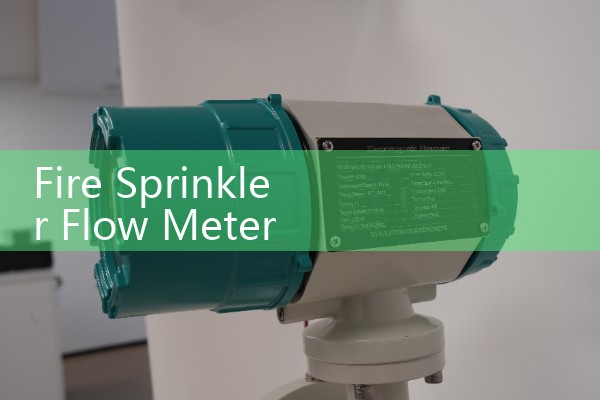
For a permanent test drain or fire pump test header, an inline electromagnetic flow meter is often the better tool. The Silver Instruments SIL-EMF series covers DN15 to DN400. It provides 4-20 mA HART output, pulse output, and RS485 Modbus. The sensor has no moving parts, so it tolerates rust particles, dirty water, and air pockets. We recommend a hard rubber liner for fire water that sits stagnant. For higher pressure fire pump lines, choose the PN40 flange rating option.
Field Procedure for a Reliable Flow Reading
First confirm the inspector test valve is fully open. Second mount the portable ultrasonic transducers on a straight run. Allow at least 10 pipe diameters upstream and 5 pipe diameters downstream. For a DN100 pipe that means about 1 metre upstream and 0.5 metre downstream. Third enter the pipe outer diameter, wall thickness, and material into the meter. For a DN50 steel pipe schedule 40, the outer diameter is about 60.3 mm and the wall thickness is about 3.9 mm. Fourth open the test valve and record the flow for 60 seconds. Look for stable flow. For a K factor 5.6 sprinkler at 1.4 bar, expected flow is about 80 to 95 litres per minute. Your exact number depends on the head K factor, orifice size,
If the flow reading jumps or drops without a valve change, you likely have air in the pipe. Move the sensor to a vertical pipe section with upward or downward flow. Air collects in horizontal dead legs and corrupts the ultrasonic signal. We have seen this on customer sites many times. A stable reading is more important than a fast reading.
Water Motor Alarm Test and Common Failures
The water motor alarm should respond to flow, not just pressure. On one job in Jakarta, a building maintenance team opened the inspector test valve and heard no gong. The pressure gauge showed normal static pressure. We placed a SIL-UF100 on the DN100 riser and measured only 0.4 m/s. The inspector test branch was partially plugged with rust scale. The actual flow was about one third of the expected one sprinkler flow. The pipe pressure looked fine because the system was not delivering volume.
Another common failure is a closed alarm line valve. Sometimes a technician shuts the alarm line for maintenance and forgets to reopen it. A flow meter on the main riser will still show flow during the inspector test, but the alarm line will not move. Always check the alarm line valve position before blaming the flow meter or the water motor gong.
We also see check valves that stick. The alarm check valve or the flow switch may stay closed when flow starts. A portable flow meter helps you prove that the main pipe is moving water. From there you can isolate the alarm line or the electronic flow switch.
Recommended Silver Instruments Models
For most inspector test and water motor alarm audits, start with the SIL-UF100 portable ultrasonic flow meter. It works on carbon steel, stainless steel, and copper pipe from DN15 to DN200. For permanent fire pump test lines, choose the SIL-EMF electromagnetic flow meter. It covers DN15 to DN400 and has 4-20 mA HART output plus RS485 Modbus. Accuracy is plus or minus 0.5 percent of reading for flow velocity from 0.3 to 10 m/s. Both models are supported by Silver Automation Instruments technical team for fire water applications in Southeast Asia, the Middle East, and Latin America.
FAQ: Fire Sprinkler Flow Meter Testing
Question: What flow rate should the inspector test connection produce?
Answer: The flow should be close to one sprinkler discharge. For a K factor 5.6 sprinkler at 1.4 bar, the typical flow is about 80 to 95 litres per minute. Check the sprinkler data sheet and the pipe pressure to calculate your site value.
Question: Can a clamp-on ultrasonic flow meter read fire sprinkler pipes accurately?
Answer: Yes. It needs a clean pipe surface, correct pipe parameters, and enough straight run. On steel or copper pipe from DN15 to DN200, the SIL-UF100 gives reliable comparative flow data for alarm and pump tests.
Question: Which meter is better for a fire pump test line, ultrasonic or electromagnetic?
Answer: For a permanent fire pump test line, an inline electromagnetic meter is better because it works in a full pipe and does not depend on pipe coating or signal coupling. For temporary audits, a portable ultrasonic meter is more flexible and does not require pipe cutting.
Question: Why does the water motor alarm not sound even when pressure is normal?
Answer: The water motor alarm needs flow, not just pressure. A blocked inspector test connection, closed alarm line valve, plugged strainer, or stuck alarm check valve can stop the alarm. A flow meter on the riser shows whether water is actually moving.
Question: What information do you need to select a flow meter for fire system testing?
Answer: Send us pipe material, pipe size (DN), flow range, pressure (bar), temperature, and signal output. For portable ultrasonic models we also need pipe wall thickness. For inline electromagnetic models we need flange standard and liner preference.
Contact Silver Automation Instruments for a fire sprinkler flow meter quote. Send us your pressure (bar), temperature in degrees Celsius, pipe size (DN), and flow range. Tel: +86-25-68650347. Whatsapp: +86-25-52155837. WeChat: +86 15365082610.
 Hot Blog
 Related AD